Episode 3: Follow the Data - Understanding Flow Before You Modify It
Most production issues in NetSuite aren't caused by bad logic. They're caused by invisible chains.
A user saves a record. A User Event updates another record. That record triggers its own User Event. A Scheduled Script picks up changes. A Map/Reduce recalculates related transactions. A workflow sends notifications. Suddenly, a "small change" becomes a system-wide ripple.
Understanding flow means grasping one essential truth: in NetSuite, nothing lives in isolation.
Why One Small Change Can Break Everything

Let's walk through a common scenario. We add logic to automatically update a Customer's credit status when a Sales Order is saved. Simple enough. But here's what
actually happens:
- The Sales Order is saved.
- An afterSubmit User Event updates the Customer record.
- The Customer record's User Event recalculates credit exposure.
- That recalculation updates open invoices.
- The Invoice update triggers another User Event.
- A Scheduled Script runs nightly to reconcile balances.
Now imagine we add one extra field update to the Sales Order. The downstream impact compounds fast:
- Credit recalculations double-run.
- Scheduled processes take longer.
- Governance spikes.
- Records lock unexpectedly.
- Finance sees inconsistent balances.
The code itself may be correct. But we inserted it into a moving river without understanding the current.
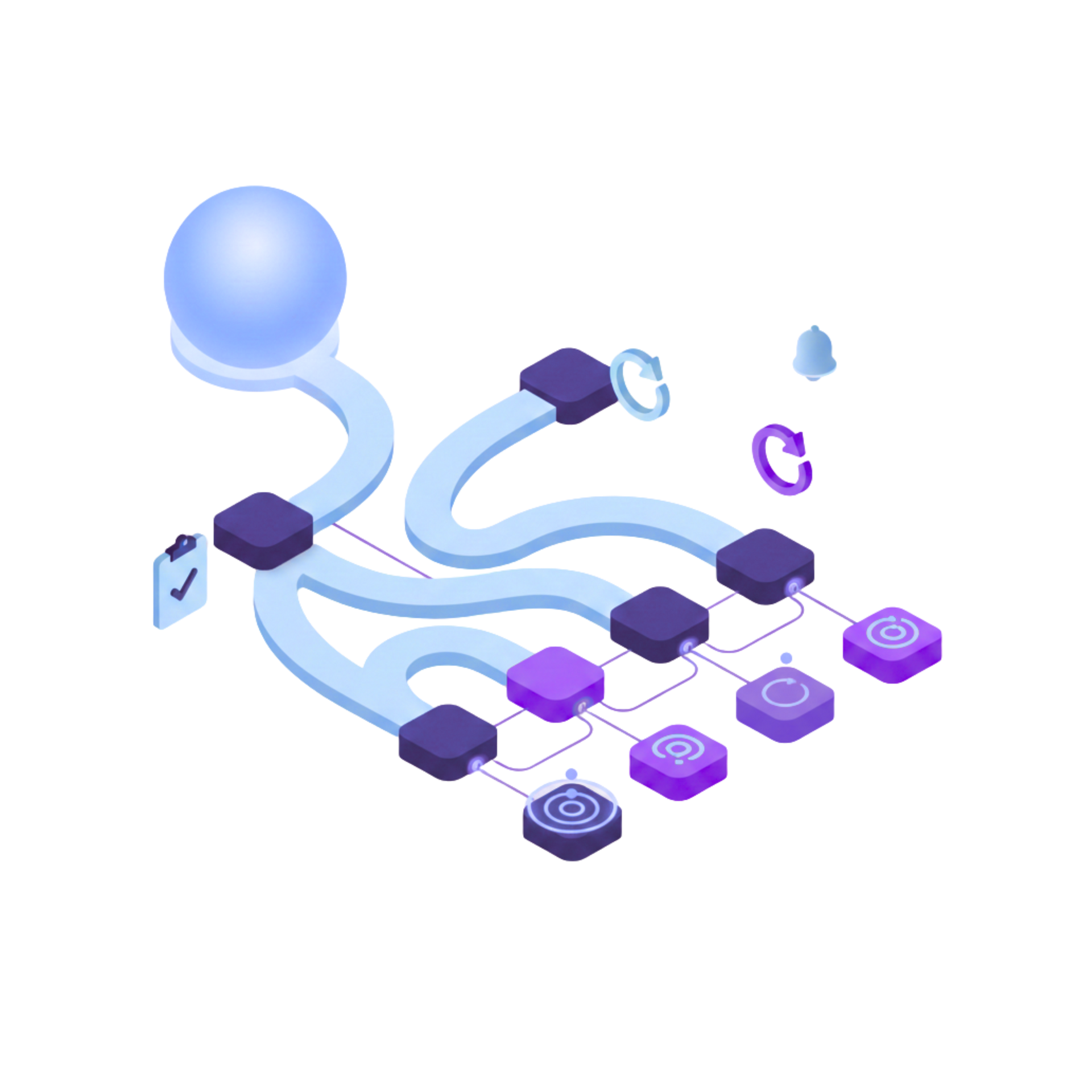
Most cascading failures happen because we modify a node in the chain without mapping the chain first. Understanding flow before writing a single line of code is what separates stable systems from fragile ones.
How to Map Data Flow Before Making Changes
Before modifying or introducing logic, let's discipline ourselves to trace the full picture.
1. Identify the Trigger Point
Start with the originating event and ask:
- What record initiates the change?
- Which script type fires first — beforeSubmit or afterSubmit?
- Does it write to other records?
Never assume the flow stops at one script.
2. Trace Downstream Updates
Follow every write operation. In NetSuite, writes are triggers — and every write is a potential cascade.
- Does this script update another record?
- Does that record have its own User Events?
- Are workflows attached?
- Are Scheduled or Map/Reduce scripts consuming those changes?
3. Separate Domain Logic from Transport
A common anti-pattern is embedding business rules directly in entry-point scripts. Instead, let's keep things clean:
| Approach | What It Looks Like | Why It Matters |
|---|---|---|
| Extract domain logic | Reusable modules handle business rules | Easier to test and maintain |
| Keep entry points thin | Script files only route and trigger | Reduces hidden dependencies |
| Make data movement explicit | Clear handoffs between scripts | Flows become easier to trace |
When logic is centralized and transport is thin, understanding flow across the system becomes far more manageable.
4. Draw It Out
Architectural judgment improves dramatically when we visualize. Even a simple diagram prevents accidental duplication, recursion, or unintended loops:
Sales Order → Customer Update → Invoice Recalculation → Scheduled Reconciliation
If you can't explain the flow in one diagram, you don't fully understand it yet.

The Mental Model That Changes Everything
Think of NetSuite as a network of reactive nodes. Each record isn't just storage — it's a trigger. Each write isn't just persistence — it's activation.
Architectural maturity means asking one question before every change: "If I modify this here, what else wakes up?"
Small changes don't stay small in reactive systems. They propagate. Understanding flow — how data moves, where it triggers, and what it activates — is the foundation of every reliable NetSuite build.
Build With Confidence
Understanding flow is essential, but applying it consistently across a growing codebase takes experience and discipline. At ATSOURCE, we help NetSuite development teams build systems that are stable, traceable, and designed to scale without surprises.
Let's talk
about how your team can develop with architectural clarity from day one.

Meet the Author
Jona has over a decade of experience in SuiteCloud Development on the NetSuite platform. She specializes in implementing advanced solutions and has led teams in creating high-quality software. Jona holds multiple certifications and has been recognized with awards like the Summit Award and Quality Champion Award.
Tags
Accelerate ERP Success with Expert Solutions
Ready to put what you've learned into practice? ATSOURCE delivers both the specialized talent and comprehensive NetSuite support you need to turn strategy into results.Connect with our experts today and move from planning to performance.